Tourism, Hospitality Sectors Face Skilled Manpower Crisis Amid Soaring Demand
- Post Time : Saturday, August 2, 2025
Industry leaders warn of missed opportunities as universities lag behind market needs
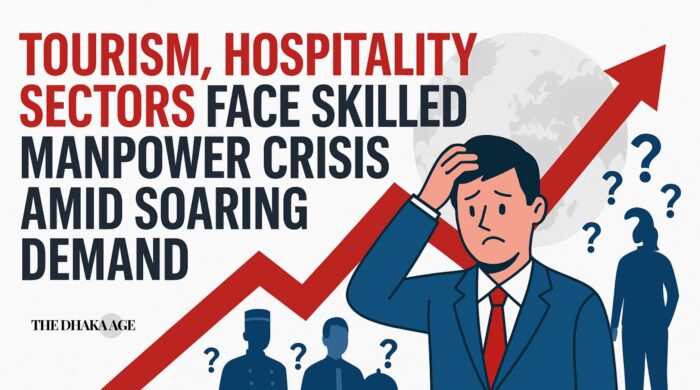
Dhaka, August 2, 2025 — Bangladesh’s booming tourism and hospitality industry is facing an acute skilled manpower crisis, threatening to derail its growth prospects amid soaring demand. While the sector is set for rapid expansion, academic institutions are failing to produce enough trained graduates, prompting concerns from both private operators and policymakers.
According to the Bangladesh Tourism Board’s `National Tourism Human Capital Development Strategy‘, workforce demand is projected to surge by 45% by 2030, rising from 2.9 million in 2022 to over 4.3 million. But industry leaders warn that unless urgent reforms are made in education and vocational training, the country may miss out on this economic opportunity.
Alarming Gaps in Skilled Workforce
One of the starkest challenges is that nearly 80% of tourism graduates do not enter the sector, citing low pay, poor job satisfaction, and limited career progression. This vacuum in skilled human resources has forced many luxury hotels, airlines, and tour companies to hire foreign professionals, especially in senior management roles.
`The gap is stark in leadership, finance, and culinary departments,’ said the General Manager of a five-star hotel in Gulshan, speaking to The Business Standard. `Our interns and entry-level staff fall short because academic programmes don’t cover essentials like revenue management, cost control, or digital hospitality marketing.’
He also noted that international hotel brands often hesitate to trust local candidates for top-level positions, exacerbating the reliance on foreign experts.

Deficiencies in Communication and Language Skills
The Tourism Board’s study revealed serious skill deficits within the industry.
- 27% of employees lack basic communication skills,
- 22% in the restaurant sector underperform in customer service,
- 27% of tour operators cannot speak a foreign language — a major drawback in dealing with international clients.
“We’re seeing a surge in tourism entrepreneurs,” said Taufiq Rahman, CEO of Journey Plus. “But they’re struggling to find skilled manpower. Especially in operational roles like sales, marketing, itinerary planning, or client communications, the gaps are alarming. Finding multilingual guides is even harder.”
By 2030, sector-specific staffing needs will include:
- 4.07 lakh in accommodation,
- 24 lakh in restaurants and fast food,
- 2.63 lakh in entertainment,
- 90,280 in travel agencies and tour operations,
- 15,342 in tourist vessels,
- 25,099 in bus and coach services,
- 34,422 in airlines.
The amusement park sector, already drawing 60 million ticket sales annually, is expected to create another 100,000 jobs by 2030.
Educational Institutions Lagging
Despite the growing demand, educational supply is severely limited. Currently, about 35,000 graduates are produced annually, compared to the required 150,000–200,000 skilled workers per year.
`Public universities rarely update their curriculum, and practical training is almost non-existent,” said Dr Md Anowar Hossain Bhuiyan, associate professor at the National University. “Graduates are not market-ready.’
He pointed out that low starting salaries are a major deterrent. While banking or government jobs may offer Tk 30,000–40,000, tourism graduates often start at just Tk 15,000–20,000.
As a result, many graduates abandon the sector altogether. One Dhaka University graduate shared that he chose a government bank job instead due to better pay and career prospects.
Currently, 52 institutions offer tourism education in Bangladesh — including 25 universities and 11 National University-affiliated colleges. However, diploma tracks are producing more industry-ready graduates, generating about 8,000 skilled workers annually.
“Unfortunately, most university graduates don’t stay in the sector,” said Taufiq Rahman. “We need three times the current workforce, but this shortage is pushing people away.”
Efforts to Bridge the Divide
Abu Tahir Muhammad Zaber, CEO of the Bangladesh Tourism Board, noted a mismatch between graduate expectations and industry demands.
`Graduates expect to enter management immediately, but the industry wants them to start with front office or housekeeping roles. Many refuse,` he said.
In contrast, diploma holders, who complete four months of theory and two months of practical training, often outperform university graduates in entry-level roles.
Mohiuddin Helal, Chairman of the Tourism and Hospitality Industry Skills Council, acknowledged that current training capacity falls well short of the required scale.
`We need more quality institutions and training centres,’ he said. `We plan to skill 7,000 workers over the next three years, both for local absorption and overseas opportunities.’